Let’s get something out of the way: This might just be the most ambitious blog I’ve ever written. As someone who consults regularly with large groups of first-time founders, I know firsthand just how much ground there is to cover when it comes to developing a 101 guide to marketing.
I can’t teach you everything you need to know right now. But there are concepts, ideas, language, strategies, and resources I can hand over to you that will set you up for success.
So, don’t expect to sit down and read this from top to bottom in one go.
Take your time.
Read a concept. Think about it. Reflect on your business. See if you need to take immediate action.
Then move on.
The table of contents below will prove incredibly helpful. Use it.
And, of course, please reach out if you have additional questions. We love talking shop! Contact us.
Table of Contents
Getting Your Mind Right
Understanding Your Business
Understanding the Buyer's Journey and Sales Funnel
Your Marketing Toolkit
A Marketing Campaign Primer
Moving From Marketing to Sales
My Favorite Marketing Resources
Find Hands-On Marketing Support
Getting Your Mind Right
Before we get into the nuts and bolts of marketing strategy and execution, spend a few minutes reflecting on some core concepts intended to get us ready for the larger message in this blog:
1. A Simple Overview of Marketing
We have a tendency to overcomplicate marketing. And, look, it is complicated. Modern marketing is built on towers of research and human psychology, and understanding all of that makes marketing significantly easier.
But you don’t have to spend the next 10 years poring over every study. Instead, remember this as your anchor point:
Marketing is:
- the right message
- to the right audience
- at the right time
- in the right place.
Let’s break that down:
- The message – This is what you’re trying to communicate. It could be your core offer, your brand story, your mission, or a direct call to action. Great messaging is simple, specific, and emotionally resonant.
- The audience – This is who you’re trying to reach. You’re not marketing to “everyone.” Instead, you’re speaking to a clearly defined group of people who will benefit from what you’re offering.
- The time – Timing is everything. Your audience has to be in the right mindset to receive your message. That could mean hitting them when they’re actively searching (like with Google Ads) or slowly building interest over time (like with social media).
- The place – Where your message shows up matters. Email, Instagram, TikTok, and local networking events—they all serve different purposes. You have to show up where your audience already is.
Why All Of This Matters: We all get frustrated with marketing from time to time. We’ll look at our website metrics and be mad that our visitors didn’t behave the way we expected, or we’ll look at our advertising spend and be surprised at how few sales we generated. All of these problems can be overcome—and our pathway forward starts with optimizing the right message for the right people at the right place at the right time.
2. Small Business VS Big Business
My parents were business owners for about three decades (until they finally sold their businesses to retire early). When I started Poetica, my dad offered this advice:
If you treat your business like a small business, it’ll stay a small business. If you treat it like a big business, it’ll become a big business.
Here’s what he meant:
If you treat your SMB like a side hustle, you’ll have a tough time growing it. New SMB owners have a ton of responsibilities. In many cases, they’re in charge of marketing, sales, customer service, accounting, fulfillment, and every other single responsibility.
It’s a fast track to burnout.
But here's the key: You can be small and still act like a real business. That means creating systems. Scheduling campaigns. Testing ideas. Documenting your brand strategy. Investing in tools. Reviewing data.
You may not have a 20-person team—but you can think like a company that does.
And that means taking your marketing seriously.
Why All Of This Matters: You can’t half-ass your marketing strategy and expect great results. I’ve seen business owners agonize over the wrong things and be genuinely surprised when they haven’t generated a single lead in weeks. If you’re serious about your business succeeding, you need to be equally serious about your marketing strategy.
3. The Hedgehog Concept VS Ikigai
In Jim Collins’ classic business book Good to Great, Collins compares companies that have consistently grown over time (like GE and IBM) to the mom and pop stores that have only held steady.
One of the biggest differentiators, he found, was the hedgehog concept—the practice of focusing on:
- What you’re passionate about
- What you can be the best in the world at
- What you can make money doing
If you can drill down into something super specific, Collins argues, you can build a business that lasts and grows.
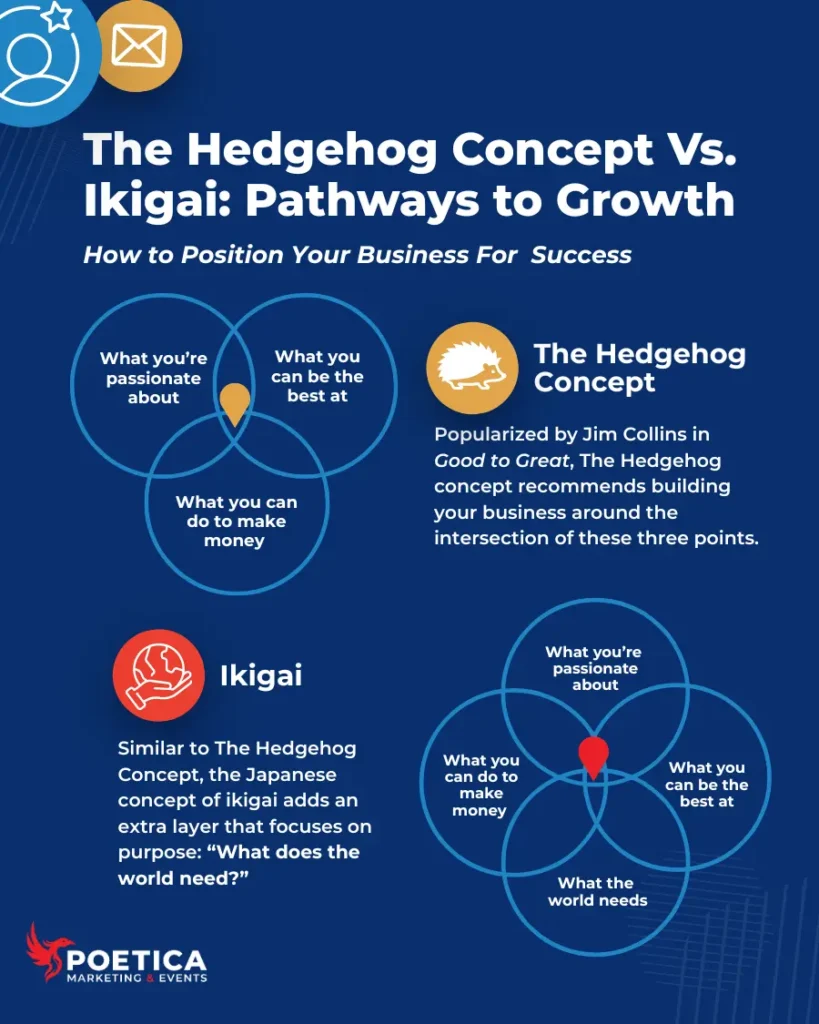
When I coach first-time entrepreneurs, I often refer to the hedgehog concept as a starting point for understanding what makes them different from the competition, but then I also nudge them to think a little deeper about a related Japanese term:
Ikigai.
Ikigai takes the hedgehog concept a step further. It includes:
- What you’re passionate about
- What you can be the best in the world at
- What you can make money doing
- What the world needs
Ikigai adds purpose to profit. It reframes the business journey from a personal ambition to a meaningful societal contribution.
Why All Of This Matters: I like the concept of ikigai because it jumpstarts the conversation around what makes your business unique and why it exists in the world. When we flip the script from, say, “I sell vacuum cleaners” to “I create calm, peaceful homes by equipping homeowners with the tools to clean and organize their lives,” we can begin to create powerful branding and marketing campaigns. Bonus: It also kicks off the classic Simon Sinek prompt of “Start with why,” which is equally powerful.
Understanding Your Business
I’m going to say something bold:
You probably don’t understand your business.
I’m not trying to be mean, flippant, or ignorant. I’m being serious: Most business owners we talk to (even those who have been in business for 10+ years) don’t really understand the core of their business—the nuances that make it meaningfully different from the competition.
And that’s where your real marketing opportunities come from.
The deeper you can understand your business for the unique entity it is, the better you can build an original marketing engine for sustained growth.
So, how do you start to truly understand your business? Well…
How to Understand Your Business
Here’s a three-pronged approach to getting into what really matters—so you can start developing truly compelling and creative campaigns.
1. Understand your audience
Your target audience isn’t “anyone.”
Think about it. Nike isn’t for couch potatoes; they’re for athletes. Adobe isn’t for alpaca farmers; they’re for creative professionals. Men’s Warehouse isn’t for your 85-year-old grandmother; they’re for men who want to dress nicely.
Your job is to push the envelope. The more specific you can be, the better your marketing can become—because your visuals and copywriting can become hyperspecific.
For example, let’s say you run a medical supply store. There’s a difference between saying “I work with doctors” and “I work with surgeons.” And there’s a difference between saying “I work with surgeons” and “I work with orthopedic surgeons.” And there’s a difference between saying “I work with orthopedic surgeons” and “I work with orthopedic surgeons who specialize in pediatrics and run a practice that generates more than $20 million per year.”
As you drill down into the specifics, you’ll find you can speak directly to your target audience’s unique pain points—which will make your marketing even more powerful.
2. Understand Your Competition
Once you’ve clearly defined your audience, it’s time to turn your attention outward—because marketing doesn’t happen in a vacuum.
If you don’t know how your competitors are showing up in the market, you risk:
- Blending in with the noise
- Overpromising on something your competitors do better
- Underselling the exact thing that sets you apart
Start by analyzing at least 3 competitors. Then, answer the following:
- What are they saying in their marketing? What’s their core message? Do they lean into speed, affordability, luxury, results, values, community, or another angle? Take note of what they emphasize.
- How do they present themselves? Check out their website, their social media channels, their photography, and even their business cards. Do they seem modern or outdated? Polished or DIY? Serious or playful?
- Who is their target audience? Are they going after budget-conscious buyers or high-end clients? Are they focused on moms, students, retirees, or executives?
- What advantages do they have? Do they have more locations? A bigger team? Better pricing? More Google reviews? A more established brand presence?
- What disadvantages do they have? Are their services vague? Is their branding inconsistent? Do they seem to lack personality or a clear voice?
This step isn’t about copying what others are doing. Instead, it’s about finding your unique position. When you understand where your competitors stand, you can find a lane of your own.
3. Understand Your Differentiators
Now that you know your audience and your competitors, it’s time to do the deep work: defining what makes your business unique.
Most business owners stop at the basics—“we offer great service” or “we care about our customers”—but here’s the truth: that’s not a differentiator. That’s a requirement.
A real differentiator is:
- Something your competitors can’t easily copy
- Something your customers notice and care about
- Something that shows up in every touchpoint of your brand
To get started, ask yourself these questions (and don’t rush through them):
- What makes your solution better or different than your competitors’?
- What beliefs or values shape how you do business?
- What’s your secret sauce, your unfair advantage, or your origin story?
- What makes dealing with your business unique?
To help, here are a few examples of strong differentiators:
- A proprietary process that delivers results 25% faster than the competition
- A niche focus on a very specific audience (e.g., “financial planning for divorced women over 40”)
- A founder-led business that infuses creativity and personal storytelling into every project
- A customer experience that’s radically more responsive, thoughtful, or fun
Once you lock in your differentiators, your branding, copywriting, and campaign ideas all start to align—and your message becomes instantly more magnetic.
Write It Out
A great way to hone your unique position in the market is to write it out.
Seriously.
For years, consultants have recommended a simple formula, and it works both as an elevator pitch and as a north star in the rest of your marketing.
But it only works once you’ve done the previous homework steps. If you haven’t finished the rest of the recommendations in their article, go back and do the heavy lifting first!
To get started, complete this sentence:
I help [ Specific Customer ] do [ Objective ] by [ Your Unique Solution ] for [ Outcome ].
Get as specific as possible.
For Poetica Marketing, we might say:
We help service-based SMBs under $10 million in annual revenue generate and nurture high-value leads through comprehensive branding, marketing, and event strategies that carry all the way through the sales process for long-term business growth.
The clearer you can be, the more specific your unique audience and value proposition.
And here’s the unexpected benefit: The more granular you become, the more valuable your business appears.
Understanding the Buyer’s Journey and the Sales Funnel
Whether you realize it or not, we’re all in someone’s sales funnel right now.
If you search for “buyer’s journey” or “sales funnel,” you’ll find a variety of different sketches, but they all boil down to essentially the same thing. Here’s how we like to think about them:
The Buyer’s Journey
Awareness Stage - In the awareness stage, a consumer is aware that they have a problem. Maybe their roof is leaking, or maybe their car is making a strange sound.
Consideration Stage - In the consideration stage, the consumer considers different solutions. They may evaluate different roofers, handymen, or contractors for their leaking roof, or they might check reviews for different mechanics to fix their car.
Decision Stage - In the decision stage, the consumer decides on a solution. Ideally, this is when they choose your company, but they could also choose a competitor or inaction.
The buyer’s journey is closely related to the sales funnel, which is the way a consumer gradually moves through your system to become a paying customer.

Like the buyer’s journey, the sales funnel can be drawn and labeled in a variety of intricate ways, but it essentially boils down to this:
The Sales Funnel
Awareness - A consumer is aware that your company exists. Think of the awareness stage like the ads you see when you’re watching something on YouTube or the commercials you see when you’re watching the news after work.
Interest - A consumer is interested in the solution your company provides. At this stage, the consumer has a problem and is ready to start looking for solutions.
Those ads you saw while on YouTube or watching TV? Those are suddenly relevant. Here, a consumer might sign up for your newsletter, follow you on social media, or request a brochure.
Decision - A consumer is ready to make a purchasing decision, and they may even weigh their options against you and a competitor.
Action - The consumer finally makes their purchasing decision. They might visit your store, hop onto your website, or slide into your Instagram messages to jumpstart the sales process.
Why the Buyer’s Journey And Sales Funnel Matter
Marketing and Sales are complicated theoretical frameworks that rely on technology, psychology, and communications to drive a desired financial outcome.
When we simplify these concepts into the basic components, we make them radically easier to understand and manipulate.
If you’ve even been on a sales call or consultation with me, you’ve likely heard me compare this to “seeing the matrix.” Just as Neo sees the ever-scrolling code in The Matrix series, you can better understand the countless factors of Marketing and Sales when you know how they’re put together.
And, much like Neo, when you see how something’s put together, you can begin to manipulate it.
Your Marketing Toolkit
You have more marketing resources at your fingertips than you may realize. Here are some of the most commonly used marketing tools:
1. Website
Your website is the Swiss army knife of your digital marketing strategy. It has a multi-pronged attack that includes:
- Digital Storefront - If you’re selling online, the eCommerce side of your site can attract and convert eager customers.
- Services Pages - Likewise, your services pages are critical for attracting potential clients and pulling them down the sales funnel.
- Blogs - Blogs are frequently misunderstood in a digital marketing strategy, but here’s what you need to know: Blogs are powerful search engine optimization resources that can drive organic traffic to your website.
By consistently optimizing your website, you can fine-tune it into the powerful marketing and sales resource it is.
2. Google Business
Formerly known as Google My Business, this is your business’s profile on Google, where it lists your address, contact information, and reviews. If you run an eCommerce shop, this likely isn’t very important, but it’s critical if you run a local brick-and-mortar or a service-based company.
Your Google Business profile can significantly boost brand visibility and can even serve as a cornerstone to your overall SEO strategy.
3. Social Media
Look, there’s a ton we could say about social media, but we’re not here to write a book. Instead, we want to emphasize two things:
1. Social media is most valuable when you hang out where your audience is. In other words, if you sell office printers, you should probably be on LinkedIn, not Snapchat.
2. A great social media strategy requires much more than spamming the feed and cheap attention-grabbing tactics. “Going viral” isn’t easy, even if you resort to cliche tactics like “sex sells,” as I mentioned in a recent LinkedIn post:
Here’s my final point about social media for now: You’ll get out what you put in. Weak or lazy social techniques generate underwhelming results. But if you’re focused and strategic, you can spur meaningful ROI.
4. Email
There are a few different ways to think about email marketing:
1. Outbound email - As a values-based agency, we fundamentally disagree with outbound email tactics. Yes, mass sending targeted emails to cold prospects can generate sales when it’s done at scale, but it comes at the risk of damaging your reputation. Still, it’s a strategy we need to highlight since it’s so prevalent.
2. Lead nurturing - Email is a powerful “lead nurturing” tool, meaning it can help you stay in front of consumers who are interested in your brand and may turn into paying customers in the future.
3. Automated sequences - You can set up automated email funnels that reach out to leads on your behalf. Usually, these are set up through a triggering event, like when a site visitor completes a form or downloads an eBook from your website.
5. Business Card
I know business cards are dying out, but if you spend any time networking (which we’ll talk about in a moment) or meeting prospects in person, you should probably have a business card.
And if you’re going to have a business card, you might as well make the most of it. Yes, you can just throw your logo and contact information on there, but there are other ways of spicing it up and standing out. A few ideas:
- Add a QR code for people to scan and jump right to a specific webpage.
- Consider unique business card designs (like a star or a square) so it stands out.
- Consider something that’s not a card. We’ve seen people use credit-card-thin flash drives as business cards so they’re both legible and practical.
Some business owners love to use single business cards like DOT—cards that are meant to be scanned so their contact information can be quickly saved or so that users can immediately connect with them on LinkedIn.
I generally dislike these over traditional business cards because there’s no tangible marketing material for the other person to take home.
After a long night of networking and meeting dozens of people, you’ll have an easier time remembering someone whose card you still have in your pocket (versus the person whose name you scanned and immediately forgot).
6. Brochure
Yes, brochures still matter—especially in service-based businesses or at local events, conferences, and community gatherings.
Brochures are your “offline sales pitch in print”—something a potential customer can physically hold, flip through, and take home with them. That tangibility creates trust, especially when the design and messaging feel intentional.
Pro Tip: Don’t just list your services. Use the space to tell a story, speak to benefits over features, and always include a strong call to action.
7. Ads
Oooh, boy, there’s a lot to be said about advertising in the 2020s. I’ll try to keep it as succinct as possible by talking through both digital advertising and traditional advertising:
Digital Advertising
Today’s digital ad platforms offer some of the strongest targeting capabilities in human history. You can reach a niche audience with pinpoint accuracy using platforms like:
- Google Ads – Ideal for high-intent search traffic ("emergency roof repair near me")
- Meta Ads (Facebook & Instagram) – Great for lifestyle brands, event promotion, and local services
- LinkedIn Ads – Perfect for B2B companies targeting professionals by job title, industry, or company size
- Display – Advanced setups that let you run ads on news sites, blogs, and apps across the web
You can also geotarget your ads to reach people in specific ZIP codes, regions, or even building footprints—ideal for hyper-local marketing.
Traditional Advertising
Yes, traditional advertising still works—when done right. A few examples:
- Print ads are great for niche magazines, trade journals, and community newspapers
- Billboards can offer unmatched visibility in high-traffic areas (though expensive)
- TV and streaming are no longer just for big brands—streaming ad platforms now allow regional and even zip-code-based ad targeting
The key with all advertising: Track your ROI. Every dollar should do something measurable.
8. Radio
Don’t sleep on radio—especially if your business is tied to a local audience.
Radio advertising offers one major benefit: reach. You can get in front of thousands of commuters, office workers, or stay-at-home parents with a single well-timed spot. Plus, some radio spots are surprisingly affordable.
We generally recommend radio for:
- Event promotion (concerts, festivals, fundraisers, launches)
- Location-based businesses (restaurants, mechanics, local boutiques)
- Service-based businesses with clear hooks (“Need help with your taxes? Call XYZ!”)
Bonus: Explore Spotify or podcast ads for a similar audio-based approach with digital targeting options.
9. Networking
Networking isn’t just handshakes and business cards—it’s free marketing rooted in relationships.
If you’re in the early stages of business, this is one of the fastest, most cost-effective ways to build trust, generate referrals, and grow your brand.
Smart networking includes:
- Attending local Chamber of Commerce events
- Joining referral groups like BNI or AmSpirit
- Showing up consistently at industry mixers or workshops
- Reaching out 1:1 to potential collaborators or service providers
You’re not trying to “sell.” You’re showing up with value, curiosity, and consistency. And that builds a reputation faster than any algorithm ever could.
10. Press
Let me dispel a common myth for you right now: Press is not dead. There is still incredible value in press placement, and it’s still possible to achieve high-value coverage in today’s world.
First, let’s explore why press coverage is so valuable:
- Social proof - Being featured in a third-party publication demonstrates value—and you can use that to your advantage.
- SEO lift - Having another legitimate website link to yours provides an SEO lift that can help your site rank better in search results.
- Traffic boost - As people read your article online, they’ll find a link to your website.
- Brand awareness - An article creates greater awareness around you and your brand, which creates long-term marketing and sales opportunities.
- The power of storytelling - Our brains are designed to remember stories, and press coverage often includes some sort of story that will help readers remember you and your brand longer than they would if they saw a simple advertisement.
So, we know PR is powerful, so why aren’t more brands taking advantage of it?
Well, because most brands don’t understand it.
The biggest challenge to earning PR is creating a story worth talking about. But if you can create something worth talking about, you can earn meaningful press coverage!
As we mentioned in our Brand Launch Strategy guide, we helped Steel Rippers earn coverage in the Pittsburgh Post-Gazette by creating a story around the company’s formation and launch party.
Check out the full Steel Rippers story.
A Marketing Campaign Primer
OK. If you’ve read this far, you’ve covered 3,000+ words of marketing theory and foundational knowledge.
It’s time to put the pieces together into a full-blown campaign—a strategic marketing initiative over a set period of time with a desired objective.
Here are the must-ask questions to consider in your preparations:
1. What is the campaign goal? This is your north star, as a defined campaign goal influences every other decision.
The goal can be as straightforward or complex as you’d like it to be, but you need to define it. A few examples of a campaign goal:
- Announce a new service your company offers.
- Drive new potential customers to your online store during the holiday season.
- Attract new email addresses to your list so you can promote your services in the new year.
2. Who’s your audience for this campaign? Remember what we said earlier about your target audience? It should be well-defined.
During a campaign, you may want to be even more specific. Since a campaign has a specific goal, you should target a subset of your primary audience that’s ready to convert within your goal parameters.
This step might push you a little, but pausing here to really consider your campaign audience will make your creative and messaging much easier.
3. What’s the beginning, middle, and end? A campaign has multiple stages. A few questions to consider:
- How will your target audience first hear your message?
- Once they hear your message, what action steps should they take? (In other words: What’s your call to action? Don’t worry—we’ll talk about messaging in a moment.)
- How will you know when your target audience has successfully completed all of the desired steps?
4. What’s the campaign message? Here’s where your creativity comes into play. Your messaging comes across in a few different ways:
- Your “creative” - This is the imagery, photography, videography, or custom graphics you use throughout the campaign.
- Your copywriting - Look, I love talking copywriting (I started my career in B2B journalism!), but I’ll try to keep it brief: This is your opportunity to tap into your audience’s specific needs, fears, and desires to create a compelling opportunity.
- Your CTAs - Your calls to action are incredibly important within a campaign. What do you want your audience to do next? Make sure you give them a clear roadmap!
5. How will you push the message out? Remember when we talked through your marketing toolkit? You have a ton of options here, and it’s up to you to determine what channel (or channels) you’ll use to get the message to your target audience.
6. How will you track campaign performance? For years, marketing was a misunderstood stepchild. Everyone knew it was important, but few really understood why. Well, now anyone can prove the ROI of their marketing efforts with the proper metrics.
Before launching your campaign, consider your opportunities for tracking marketing metrics, and decide which metrics will be critical for measuring campaign success.
Moving From Marketing to Sales
Look, I started my copywriting career as a B2B journalism intern back in 2013, and one of the very first articles I wrote was about overcoming the feud between marketing and sales departments.
Both have the same goal, but they have wildly different opinions on how to achieve it.
But when you’re an SMB, your marketing and sales processes become much more intertwined. And, as we’ve often found, most SMBs have an easier time with marketing than they do with sales.
It’s not so hard to see why. It’s much easier to get someone interested in your solution than it is to convert them.
As an agency, we don’t believe it’s enough to lend support on marketing. We’re also obligated to offer guidance on sales.
That’s why we wrote Boost, our free eBook on tying your marketing and sales strategies together.
If you can increase your sales close rate, you can maximize the value of your leads and streamline your entire business model!
My Favorite Marketing Resources (And Some Bonus Materials)
This is the exact list of resources I give to the students in the Smart Start program I present to a few times a year. Important note: Aside from the materials we’ve obviously produced here at Poetica Marketing, we receive no kickbacks or benefits from listing other resources below:
Podcasts
Social Media Marketing With Michael Stelzner
A marketing podcast featuring a wide variety of marketing experts—often reaching outside of social media to discuss websites, SEO, copywriting, and more. Listen to Social Media Marketing.
Seth Godin’s Startup School
A collection of lectures on a wide variety of topics ranging from building a business to marketing ideas. Listen to Seth Godin’s Startup School.
Websites/Blogs
Search Engine Journal
The latest in search engine news and best practices. Check out Search Engine Journal.
Social Media Today
A look at the latest updates for social media platforms and best practices. Check out Social Media Today.
Marketing Brew
Fantastic updates on marketing news with a splash of humor. Check out Marketing Brew.
Books
Marketing Rebellion - Mark Schaefer
A look at how to win new customers in a world that hates marketing. Find a copy of Marketing Rebellion.
Content Inc. - Joe Pulizzi
A close look at the ideas behind content marketing and how to use content to build trust and win over new clients. Find a copy of Content Inc.
Unleashing the Ideavirus - Seth Godin
A look at how to build products and marketing ideas that go viral online and by word of mouth. Download a PDF of Unleashing the Ideavirus.
Brainfluence - Roger Dooley
A well-researched collection of studies and ideas for enhancing your website and marketing materials with psychology. Find a copy of Brainfluence.
The Elements of Style - EB White & William Strunk
A quick, easy-to-read book on writing best practices. Download a PDF of The Elements of Style.
Business Strategy
Podcasts
How I Built This
An inspirational podcast that interviews successful entrepreneurs to hear their stories in business. Listen to How I Built This.
Entrepreneurs On Fire
A fast-paced podcast that gets to the heart of what drives entrepreneurs and makes them successful. Listen to Entrepreneurs On Fire.
Make It Happen Mondays
A B2B podcast that talks about best practices in sales. Listen to Make It Happen Monday.
Books
The Perfect Close: The Secret To Closing Sales - James Muir
A terrific collection of practical, logical steps to enhance your sales process. Find a copy of The Perfect Close.
The Lean Startup - Eric Ries
An examination of the MVP (minimum viable product) concept in business for rapidly and cost-effectively building and launching better products and services. Find a copy of The Lean Startup.
Good to Great - Jim Collins
An examination of what separates successful companies from companies that struggle to grow. Find a copy of Good to Great.
The Design of Everyday Things - Don Norman
A fascinating look at how to build practical, user-friendly products with thoughtful designs. Find a copy of The Design of Everyday Things.
From Poetica Marketing
Podcasts
Creativity Addicts
A look at how to build a business while grappling with the most common challenges. It’s hosted by Poetica Marketing founder Pat Schober and entrepreneur John Guerrini. Listen to Creativity Addicts.
Books
The Strategic Marketer
Learn how to tie your most cost-effective marketing channels together for a big splash. Download The Strategic Marketer.
Events On A Budget
Learn how to throw high-impact events without spending a fortune. Download Events On A Budget.
Boost: The Solopreneur & SMB’s Marketing & Sales Playbook
Learn how to tie your marketing and sales strategies together for greater revenue and business growth. Download Boost.
Blogs
The Poetica Marketing Blog
Learn the latest about social media, SEO, marketing, and events. Access the Poetica Marketing blog.
Website Builders
Wix
A relatively inexpensive platform for building websites. Learn more about Wix.
Squarespace
A relatively inexpensive platform for building websites. Learn more about Squarespace.
Social Media Scheduling Tools
Note: While social media scheduling tools can be incredibly convenient, many social media platforms don’t like third-party tools, and some even say they’re against their terms and conditions. We are mentioning a few here so you’re aware of their existence, but we are not directly advocating for their use.
Meta Business Suite
A free tool for scheduling Facebook and Instagram posts. Learn more about Meta Business Suite.
Buffer
A simple, easy-to-use scheduling tool. Learn more about Buffer.
Hootsuite
A powerful social media scheduling tool with more bells and whistles than Buffer. Learn more about Hootsuite.
MeetEdgar
A scheduling tool that allows you to recycle content. Learn more about MeetEdgar.
Additional Resources
Startup Pittsburgh
A loose collective of businesses providing a one-stop shop for business owners in need of professional services (Note: Startup Pittsburgh was co-founded by Poetica Marketing!) Learn more about Startup Pittsburgh.
BNI
A networking organization that meets each week to pass referrals between members. Learn more about BNI.
Chamber of Commerce
A networking organization with lots of resources for small businesses. Learn more about the Chamber of Commerce.
Green Apple Barter
Exchange services and products with fellow business owners. Learn more about Green Apple Barter.
Find Hands-On Marketing Support
You don’t have to tackle the wild world of marketing on your own. Contact us for hands-on support.