Article Summary: AI has made SEO best practices more important than ever, and companies that ignore their websites over the next year will continue to see their online performance plummet. To continue to see strong business results through SEO in 2026, companies should focus on content depth, organization, authority, original research, and performance.
If you’re involved in marketing at any level, you likely have some sort of visceral reaction when someone mentions SEO in 2026.
Maybe you love search engine optimization, and you’re excited about the industry shifts on the horizon. Or maybe the idea of revisiting your SEO strategy causes your chest to seize up.
Either way, it’s an emotional topic. Every day, SEO algorithm updates and AI tool rollouts alter results on the search engine results page, pushing company pages further out of reach for consumers.
If you’re not paying attention, you could get left behind.
In today’s article, we’ll tap into the nuance behind SEO in 2026—and we’ll give you the keys to success in the new year with some real-world agency insights.
Table of Contents
Our 2026 State of the Union On SEO
Where to Focus On SEO In 2026
Bonus: Our Take On AI In SEO in 2026
Find SEO Support In 2026
Our 2026 State of the Union On SEO
AI has disrupted SEO in major ways, and nobody will ever be able to “coast” on the bare minimum.
As I’ve always said, the rules of SEO don’t really change from one year to the next… But the intensity at which those rules must be followed constantly increases.
Here’s why: Google (and other search engines) are no longer just research tools. They’re answer tools. Google AI Overviews and ChatGPT responses are valuable because they deliver succinct responses to complex questions.
And that’s disrupted the entire industry. But it doesn’t mean SEO is dead.
Instead, it means those who stop emphasizing SEO best practices are going to fall behind faster than ever before.
We’re seeing it firsthand with our own accounts in Search Console and GA4: Those who have ignored their websites over the last 12 months are taking massive hits.
- One account has seen a 60% decrease in organic traffic. They have neglected their website all year.
- Another account has seen a 50% decrease in organic traffic. They’ve hardly done anything to enhance their website and content all year.
The end of the summer wasn’t kind to most websites. Across the board, we tracked a massive decrease in impressions (thanks in part to massive shifts to the Google search engine results page (SERP)).
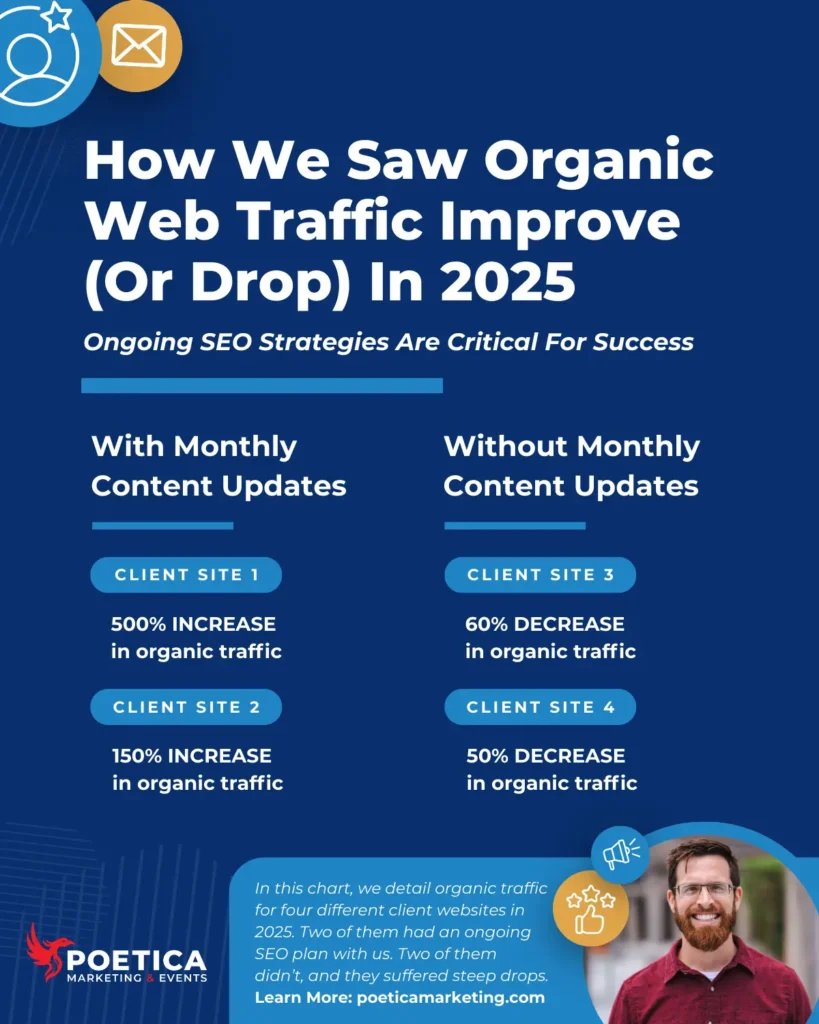
But those who have remained proactive are seeing massive lifts in overall site traffic. For example:
- One account has seen a 500% increase in organic traffic, thanks to a steady stream of blogging.
- Another account has seen a 150% increase in organic traffic in a hyper-competitive market.
That’s even after the September Google updates.
The proof is there: You can still get great results through SEO. But you have to be incredibly strategic.
Which leads us to our next point…
Where to Focus On SEO In 2026
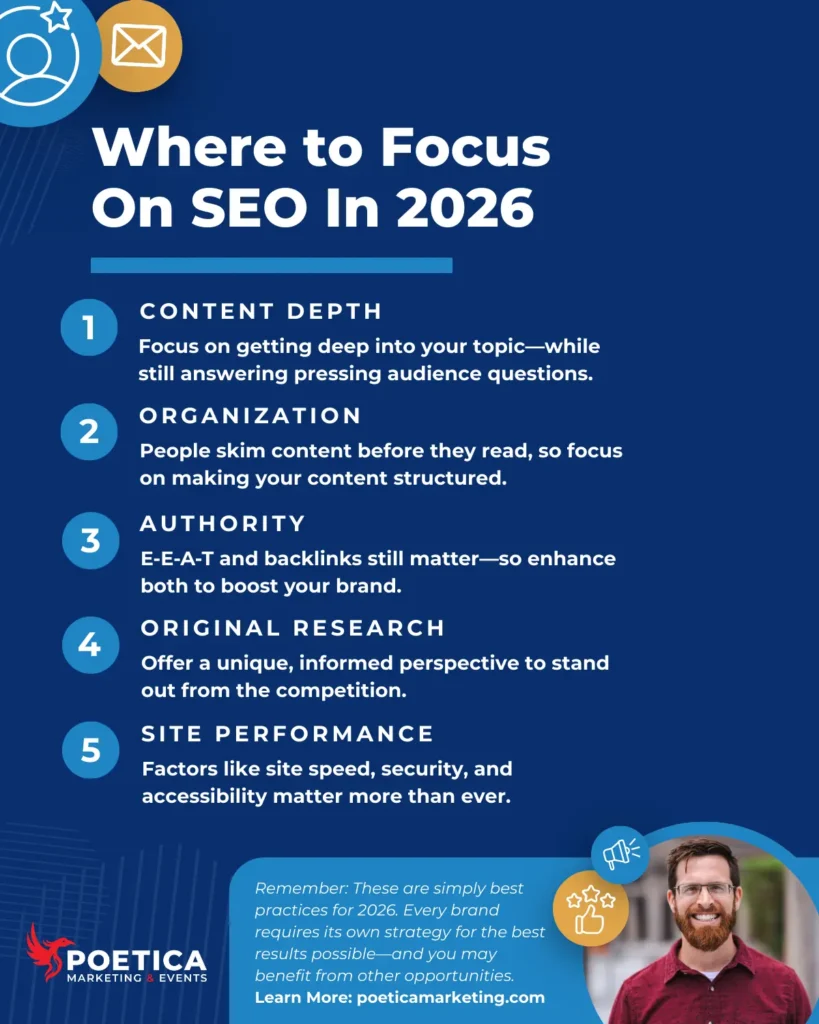
Want to steal an agency’s playbook? Here’s where we’re focusing in 2026 with our clients:
1. Content Depth
The depth you got into for your content matters. But how deep should you go?
A 2025 study from Backlinko and Ahrefs found the average result on the first page of Google was 1,447 words. That’s a significant increase from less than 10 years ago.
Consider this: When I started my marketing journey in 2017, agencies were still selling blogs that were only 350–500 words.
A few important notes on length:
- This doesn’t mean you should try to be wordy just for the sake of reaching a word count. I always recommend that new writers follow the advice outlined in The Elements of Style, and my all-time favorite writing tip in that book: Omit needless words. When you cut out excess, you increase clarity.
- 1,447 isn’t a universally magic number. The length you should aim for will vary based on your industry and target keyphrases, so check the current top 5 articles before you get started. Tip: To quickly check a page’s word count, I like to copy and paste content into WordCounter.net.
- It’s not just about word count. Fluffy content doesn’t win SEO. Word count is just a simple metric to answer another question: How deep did you go into this topic? Staying at the surface level isn’t enough anymore.
2. Organization
So, articles are getting longer as they compete for the top spot. But they’re also getting better organized, and that’s a good thing.
Remember: Countless studies have proven people online don’t read—they skim… And then they read—but only after they’ve identified the section most relevant to them.
Your content needs to accommodate readers on two levels:
- When they’re scanning for information.
- When they’re looking for a detailed answer.
So, what does this mean for the way you actually set up your blogs and other articles? Well…
1. Include a Table of Contents for larger articles. We love using them in our articles at Poetica Marketing—and you can too. Just remember to set up your anchor links so readers and jump down to the sections most relevant to them!
2. Include an article summary at the top. Article summaries are useful for readers interested in confirming they’re in the right place, but they’re also helpful to search engines and AIs trying to figure out what your article’s about.
3. Include an FAQ section. A series of relevant Frequently Asked Questions can help you elevate your content while helping you compete for related keywords on the search engine results page.
4. Include multimedia. About five years ago, I heard a well-respected local web agency recommend at least two photos per blog post. That’s no longer enough.
For context, yes, images can help break up large sections of text, but they can be much more intentional. Digital marketing expert Neil Patel explains that multimedia can increase time-on-page and user engagement.
But there’s also research on the impact of video (which can hold attention for multiple minutes) and infographics (which take time to read) versus simple decorative graphics.
When thinking about multimedia, don’t stop at a two-image quota. Think about how you can enhance your content with thoughtful content your audience will love.
5. Use Structured Data/Schema Markups. Here’s the truth about structured data and schema markups: Most digital marketers don’t even know what they are.
They’re challenging because they’re rooted in HTML coding, which is a dying relic of the internet past.
But they’re also invaluable. Structured data allows you to inform search engines what everything is on your page. Instead of them crawling your site and taking their best guess, this is your best opportunity to literally hand them information.
So, why is that still important in 2025?
SERPs are more interactive than ever. For example: When you search for a widget to buy, Google shows results with a picture of your widget and its price. That combo of data is best assisted with structured data.
Here’s the good news: You don’t have to turn into a coding expert overnight. Instead, look to tools like Yoast that can help you detail your content on a higher level.
3. Authority
Look, there are a lot of ways to unpack “authority,” and there are a ton of acronyms in the SEO space that can help you outline your pathway to success.
One of the best known is E-E-A-T:
- Experience - What is the customer experience? Is the performance of the website good, and do customers like working with you (based on customer reviews)?
- Expertise - Is your company an expert in its space? Is the author of your content a genuine subject matter expert?
- Authoritativeness - Is your site a go-to resource for information in the industry?
- Trustworthiness - Is your site secure? Do you have a privacy policy? And what about a return policy?
All of this is important, but it essentially boils down to a few things:
1. What’s your backlink strategy? Having other, credible websites linking back to yours matters. But these links are especially impactful for the pages you’re trying to rank. For example, 10 backlinks to your homepage aren’t necessarily as valuable as 10 backlinks to the most recent blog you’re trying to rank.
And, according to that Backlinko/Ahrefs study we referenced earlier: “The #1 result in Google has an average of 3.8x more backlinks than positions #2-#10.”
I’m going to be honest here: Working on backlinks sucks (in my opinion, anyway). In many cases, it’s a tedious, complicated, and thankless job—which is why so many US agencies outsource the task to backlink agencies based overseas.
That’s led to entire businesses of burying backlinks anywhere they can on the internet—even in places where it doesn’t make sense. In one SEO audit we conducted, we found backlinks on an abandoned college course message board that was still open to the public.
Not a great look. This also falls into that “black hat” SEO bucket—the type of strategy that can actually penalize you with Google.
But there are ways of being intentional and strategic with backlinks. For example:
- Publishing original research and infographics that your audience is eager to share.
- Tapping into a PR strategy that helps highlight your team’s thought leaders and shares your articles.
- Linking to your articles while guest posting on industry websites.
- Swapping blogs with your industry partners.
There’s no “right” way to backlinking, and the most important thing to remember is this:
There are no shortcuts.
2. What’s your credibility? There are a few ways to unpack credibility, and we’ll focus on a few of them here:
- Reviews - Have you collected reviews in your Google Business profile and other industry websites? And are you sharing the details of those reviews on your website?
- Testimonials - Your customers’ testimonials matter, and you can include testimonials throughout your copy.
- Author profiles - Are your author profiles detailed? Most sites we see ignore the value of a robust author profile in your blog—but they’re worth setting up. Consider including your experience, LinkedIn profile link, and professional credentials.
4. Original Research
Your research matters. And here’s the proof:
One of the most successful articles I ever wrote was for a side project. and it outranked huge publications like Vice and Rolling Stone. One of the big differences between my article and their articles was the level of research put into it—especially with quotes from industry insiders.
Research takes time to conduct, but it doesn’t have to be complicated. A few ideas to help you get started:
- Conduct LinkedIn Surveys - Running a poll with your LinkedIn audience is incredibly easy: Start a post, click the More button (the plus sign), then click the icon for Create A Poll. Now you can collect data from LinkedIn users!
- Email Surveys - If you have email subscribers, you have an audience that may be willing to complete a survey for your next piece of content.
- Internal SME Quotes - Interview some of the relevant subject matter experts within your own company, and use direct quotes in your copy.
- Partner Quotes - Don’t have subject matter experts on your team? Ask some of your industry partners for support.
Of course, more traditional research still counts here. Use external links to cite your sources, as tempting as it is not to send folks to other websites.
Note: Pay close attention to the way we’ve set up this article. You’ll notice we’ve embedded links to our sources when appropriate!
5. Site Performance
There are some factors that have little to do with the copy and everything to do with the site itself.
But before we get into it, consider this case study:
We recently built a new website for a therapist, and when we ran it through Google’s PageSpeed Insights, we had great scores on everything but Performance.
We’d hit 43 (out of a possible 100). The problem? We’d forgotten to compress our image files. Our PNGs were too large, and they were bogging down the site’s load times.
So, we converted all of our PNGs into WEBPs, making them much, much smaller files.
We ran the site through PageSpeed Insights again, and this time we scored a 93 on performance. That’s a massive win!
So, why does this matter? Search engines have to send you to great websites—otherwise they become bad search engines. Flipped another way: Users want fast websites.
But it’s not just speed… Here’s a more comprehensive checklist to help you check performance (and a few other variables):
- Site speed - How quickly do your images and other graphics load? How quickly does your JavaScript load?
- Security - Are you using HTTPS? Do site visitors have the option to control their tracking data?
- Accessibility - Did you include alt text behind your images? Do you offer your copy in multiple languages?
Bonus: Our Take On AI In SEO in 2026
It’s tough to talk about SEO without mentioning AI, GEO, AIO (and any other ingredients you’d like to add to the alphabet soup), so here’s our perspective on two critical topics:
AI As An SEO Tool
AI can provide a great starting point for content, but it’s not built for long-term business value
I mentioned in a recent interview that AI is often good for ideation and finishing up larger articles, but it doesn’t necessarily have the accuracy to run the entire show by itself:
Put simply: AI is just one more tool in an overall SEO strategy—but it should never be the entire strategy.
I’ve seen this approach run afoul. A real estate company we met once was enthusiastic about their new “SEO strategy”—one that was near-completely AI-run. They’d prompt ChatGPT with a topic, and copy and paste the response into their blog.
But it didn’t rank.
The simplest reason? They missed a ton of steps. Copying and pasting doesn’t take into account best practices such as:
- Using H2s and H3s to organize data.
- Including meta descriptions to assist search engines.
- Embedding a table of contents.
- Internal linking to relevant pages.
- External linking to relevant pages.
And that’s just for starters!
GEO & AIO In 2026
We shouldn’t go through an entire article on SEO in 2026 and not talk about its close cousin: GEO (also known as Generative Engine Optimization or AIO—Artificial Intelligence Optimization).
If you’re unfamiliar, GEO is simply the practice of getting AI to recommend your company and/or cite your content in the search results.
It was a bullish strategy for many companies throughout 2025—even when traffic to company websites declined from ChatGPT.
GEO does mark a massive shift in how consumers access information. As I hinted earlier, the Google we all knew and used five years ago was a search tool. We’d pop in a query and click links until we found what we needed.
Today’s ChatGPT (as an example) is an answer tool. It’s designed to deliver comprehensive notes so you never need to click to another website.
AI and AI overviews have plummeted traffic to traditional news media sites and even household names like Wikipedia.
And, as more and more conversations emerge about selling products through tools like ChatGPT, the entire face of online eCommerce may quickly evolve in the next few months or years.
All of this has major implications for websites, SEO, and overall digital strategies. While it’s too early to tell exactly what will happen, the important thing to remember is this:
A winning marketing strategy is diverse and resilient. It’s designed to withstand changes in the market and the overall landscape.
Find SEO Support In 2026
Need additional support for the year ahead? Contact us. We’d love to connect and hear more about what you’re building!