
Here’s something we’ve learned through first-hand experience working with a variety of different-sized clients: Event budgeting is intimidating.
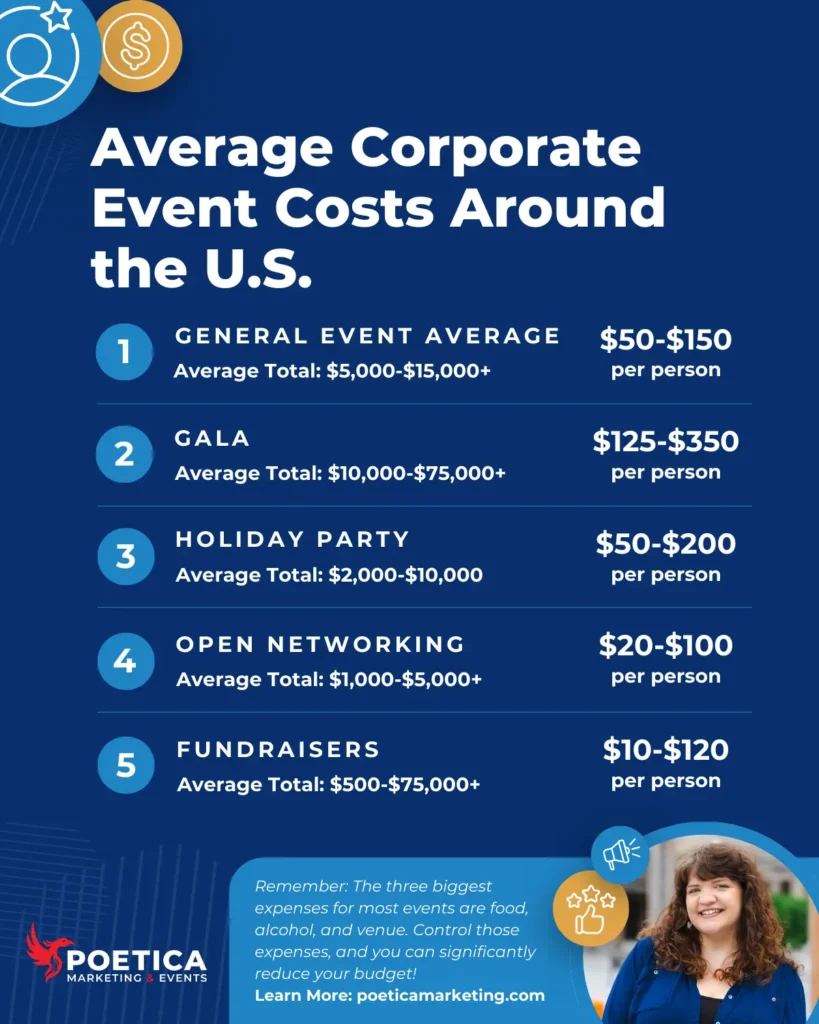
So, how expensive can a company-sponsored event become? Here’s how a few of them generally stack up across the United States:
- General Event Average: $50–$150/person (often totaling $5,000–$15,000+)
- Gala: $125–$350/person (often totaling $10,000–$75,000+)
- Holiday Party: $50–$200/person (often totaling $2,000–$10,000+)
- Open Networking/Mixers: $20–$100/person (often totaling $1,000–$5,000+)
- Fundraisers & Charity Events: $500–$75,000+ (Hint: Read How to Host A Nonprofit Fundraiser for better outcomes!)
Those estimates can sound scary, but don’t let them deter you. When you prioritize the right things, the numbers start to make a whole lot more sense—and everything becomes much more affordable.
For every line item that feels unbearably expensive, there’s another line item where you can save (big time). And knowing the difference is what sets strong event planners apart.
Related Reading: Event Planner Vs. Coordinator: What’s the Difference?
Table of Contents
- Event Budgeting 101: Where to Begin
- Types of Events and What They Can Cost
- Creating an Event Budget Sheet
- Measuring ROI
- Expenses to Expect
- The Takeaway
Event Budgeting 101: Where to Begin
Sometimes your budget is crystal clear: “We have X to spend. Period.”
That makes your work much easier.
But in most scenarios, you know what you want to accomplish but not what it will cost.
Either way, you must define three things up-front:
- What’s the goal of the event? (Brand awareness? Sales? Donor growth? Team morale?)
- Who do you want in the room?
- What style of event will get you there?
Asking these questions before you get started will guide your entire event planning journey.
Oh, and don’t think you can automatically save the day by going small! Small doesn’t always mean cheaper. In fact, sometimes that cozy 30-person dinner costs more out-of-pocket than a 300-person blowout.
Let’s talk about why.
Types of Events and What They Can Cost
There are many different types of events, and each one can scale as big or small as you wish. Usually, “scale” really refers to the number of guests and attendees, but it can also refer to the number of accommodations and how extravagant they are.
Think of a four-course dinner at a 5-star restaurant for eight people in comparison to a pizza party in the office for twenty team members. Big difference!
Small Events: 20–60 People
Counter-intuitive, but true: small, invitation-only events are often the most expensive for the host.
Why? Well…
- Limited or no ticket revenue
- Limited or no sponsorship opportunities
- You’re likely covering food + drinks for everyone instead of having them pay out of pocket
- Your venue doesn’t care if you’re hosting 10 people or 100 people… Their rate is their rate.
All of that said, this can be an affordable route. If the number of attendees is small enough, a quick reservation at a restaurant will most likely do the trick, and the cost of food and beverage will most likely be based on consumption.
Medium Events: 60–150 People
Now, let’s expand this event to 60–150 guests. We need a venue that can accommodate a larger number of people, and that usually means paying for the rental fee for a larger space.
My go-to move?
Find a restaurant, hotel, or bar with in-house catering. Many will waive the rental fee if you hit a food-and-beverage minimum. Larger venues that are used to accommodating larger groups also tend to work out their labor costs so that the host of the event isn’t paying an exorbitant amount for servers, meal prep, and clean up.
If your budget is tight:
- Find an all-inclusive venue. (Fewer minimums, one gratuity fee.)
- Consider a partner organization.
- Cut down your guest list.
- Limit the food menu and bar options (we’ll touch on this later).
- Talk to your partners to explore sponsorship opportunities (those extra dollars up front can offset your out-of-pocket expenses).
The result? An equally lovely event; goals accomplished; smarter bottom line.
Large Events: 150–500+ People
Now we’re talking scale. Yes, large events cost more—but they also unlock revenue potential and the opportunity to ease the strain on your wallet.
Think:
- Ticket sales
- VIP packages for extra revenue
- Discounted group rates
- Event sponsorships
- Community partners
- Small business features
- Greater chance of new lead generation to feed your sales engine
Suddenly, it’s not all coming from your bank account—and your event begins to fund itself. And, as we’ve mentioned a few times, an event isn’t just about the day-of. It’s about the long-term opportunity to continue marketing to your guests to turn them into happy customers.
Creating an Event Budget Sheet
Once your goals and audience are locked in, it’s spreadsheet time. (I’m not joking: This is my favorite part!)
As I always say: Dream big. Prioritize. Spend wisely.
Most event budgets revolve around three main categories:
- Venue
- Food
- Alcohol
Everything else enhances the experience—but the foundation starts here.
Ask yourself:
- Do we want live music or a DJ?
- Are we covering all costs for guests?
- Are we giving gifts?
- What will make people say, “Wow, I’m so glad to be here”?
Remember: Every add-on lives somewhere in your budget.
It all comes back to the goal and vision of the event. Where are we willing to spend extra and where can we stay more reserved in order to reach our goals?
Measuring Event ROI
An event is strategic business investment. It’s not just a party—even if it’s a company anniversary party—and it’s not just fun and games—even if it’s a community event with a carnival theme.
At minimum, your event should:
- Strengthen relationships
- Build loyalty
- Create visibility
- Generate opportunities
Here’s proof: Our most recent Poetica Marketing holiday party was supposed to be a simple celebration for our partners and clients, but our conversations with our guests turned into two unexpected sales opportunities! Not bad for a night of gingerbread houses, hot chocolate, and good vibes.
ROI isn’t always instant. Sometimes it shows up weeks, months, or years later. And the real magic happens when events become annual traditions—they grow in reach, impact, and revenue over time.
Yes, there’s a certain amount of risk, as there always is in business and in marketing, but with a power-house planning committee and clear-cut goals your event is sure to be a success.
Related Reading: BOOST Marketing and Sales Playbook
Event Budgeting Breakdown
People tend to take one of three approaches:
- Budget-Cap Style: “We’re spending X and not a penny more.”
- Seed-Fund Style: “We’ll cover the basics and use ticket/sponsor revenue to elevate.”
- Go-Big-or-Go-Home Style: “We’re investing heavily because the upside is worth it.”
A helpful mindset:
“If this event brings us one great client, donor, or partner, does it pay for itself?”
Often, the answer is yes.
Expenses to Expect
Creating an event budget can be difficult if this is a planning committee’s first-ever event or if this is the first event of its kind for the organization. Not knowing what to expect can make for some wild sticker shock throughout the process, which is why it’s important to hire an event planner or at least do thorough research before making any big decisions.
Related Reading: Event Planner Vs. Coordinator: What’s the Difference?
Venue
The perfect event venue will:
- Match your vibe
- Fit your guest count comfortably
- Provide adequate space for flow, fun, and features
- Not swallow your budget whole
Other considerations—like accessibility, location, parking, public safety, and protection from unpredictable weather—matter too. They can absolutely make or break the guest experience… but that’s a conversation for another day.
What does directly impact your budget? The venue cost itself.
Venue pricing often shifts based on:
- The day of the week
- The time of day
- The total number of hours you need the space
- The venue location/neighborhood
And that ever-important food-and-beverage minimum? It usually fluctuates right along with those variables.
In addition, sometimes service fees, labor charges, and “miscellaneous” costs are tucked away in the fine print. Be sure to ask for a detailed agreement, and read through it carefully, so you know exactly what to expect in your final bill.
Before you commit to a venue, make sure you ask:
- Are there preferred or required caterers?
- Are there rules or restrictions around noise levels or lighting?
- Can outside vendors access the space early for setup and stay late for teardown—or will that cost extra?
- What amenities are included in the rental, and what comes at an additional cost?
- Will your down payment (typically made to secure the date) be applied to the final bill?
Bottom line: do your homework and ask all the questions.
Food
Restaurants and hotels are often budget-friendly options because they roll everything together:
- The food and beverage minimum often negates the rental fee
- There’s no need to outsource tables and chairs
- There’s no fee for catering delivery
- There’s most likely a bar and bartender on site
If your venue does not have a kitchen and/or catering on site, you’ll most likely have a fee for renting the space in addition to the costs from the caterer.
As with any decision process along your way, ask all the questions you need to in order to make sure you know exactly what’s included in your invoice and what you can expect during your event.
Some questions I always ask the caterer:
- Is there a minimum cost requirement?
- Is there a menu we can pick and choose from, or can we customize our meal?
- Is there a delivery fee?
- Will there be staff staying for the duration of the event, and what is that labor cost?
- Is there an extra fee for dinnerware rental?
- Does the catering company have linens available for rent?
- Will our down payment be included in the final bill.
As far as menu choices, it’s worth exploring different options and asking for multiple quotes from your caterer. Compare, for example, the cost of “heavy appetizers” compared to a buffet-style meal or a served/sit-down meal.
And if the budget is tight, perhaps fillet mignon isn’t the best option.
Drinks & Alcohol
Generally speaking, soft drinks, tea, and water are often included with the banquet cost at a restaurant or hotel. However, if there isn’t a kitchen or bar on site, chances are you’ll have to pay extra for drink services, alcoholic or not.
The good news is that alcohol-free events are trending, and foregoing alcohol can save you thousands.
The bad news is that keeping up with a self-serve drink station (alcoholic or not) is still a lot of work. Someone has to replenish what’s at the drink station, keep the drinks chilled, clean up messes, and make sure there are plenty of cups, ice, and garnishes.
My advice? Hire the bartender/drink service. They:
- Calculate quantities before your event
- Manage consumption during your event
- Keep your guests safe
- Let you stay in “host mode,” not “barback mode”
Insurance
You likely already have business insurance—but events may need additional protection.
For a dinner party, the most you should worry about is adding the venue to your “additional insured” list and liquor liability.
That said, always ask your vendors for proof of their insurance, and you may also want to consider purchasing event-specific policies that cover weather, cancellation, and more.
Insurance costs vary significantly with every variable. It all depends on how much you want to insure for and for what level of risk.
Other Costs
Once the basic necessities are taken care of, other costs to list on your budget sheet are going to vary depending on the type of event you’re hosting and what kind of amenities you decide on.
Depending on the event, you may also need:
- Rentals
- Linens
- A/V & lighting
- Keynote speakers
- Decor
- Entertainment
- Photography & videography
- Marketing
- Coordination & staff
- Volunteers
Outdoor or unconventional venues often require extra logistics like generators, sanitation, waste removal, and weather planning.
Many of these additional needs (and costs) come back down to the venue—so choose wisely!
The Takeaway
Event budgeting doesn’t have to feel overwhelming—or restrictive.
When you start with clear goals, understand where your money actually makes an impact, and ask the right questions along the way, your budget becomes a strategic tool instead of a stress point.
Decide:
- What you want your guests to experience
- What results you want
- How much you’re willing to invest to make it happen
Then: Dream big. Prioritize. Spend wisely.
- Map out a few scenarios
- Estimate each one
- Align every decision with your goals
The right event isn’t about how much you spend—it’s about how intentionally you spend it.
With thoughtful planning, smart partnerships, and a willingness to stay focused on what matters most, your event can deliver real ROI long after the last guest heads home. That’s when an event stops being “just another line item” and starts working for your business.
And if you want a partner to make your event unforgettable—without wrecking your budget—Poetica is always here to help. Contact us to learn more.