

Article Summary: There are nearly 200,000 therapists in the United States, which means there’s a lot of competition. But here’s the good news: Most of them hate marketing. You can effectively market your therapy practice by solidifying your branding, creating content, and building referral relationships. Continue reading for our favorite therapy marketing ideas!
There’s never been more competition in the mental health field.
The US currently boasts nearly 200,000 licensed therapists, according to the Integrative Psych Institute, which is great news for clients—and bad news for you.
That’s a lot of competition.
Fortunately, we’ve spent the last few years in the agency world developing a niche in the mental health space, and we’ve worked with:
- Therapy Practices
- Psychologists
- Retreat Leaders
- Spiritual Leaders
- And more
We’re sharing some of our best therapy marketing ideas today—to help you grow your practice and enjoy the same success our clients have had!
Tip: If you need help with your marketing and branding, take our quick, self-service audit to better understand where you need assistance.
Table of Contents
The Problem With Marketing In the Therapy World (Why Therapists Hate Marketing)
How to Market Your Therapy Business
4 of Our Favorite Therapy Marketing Ideas
Find Marketing Support
The Problem With Marketing In the Therapy World (Why Therapists Hate Marketing)
Going to college teaches you how to connect with people through the proper modalities and therapeutic techniques.
But most programs completely omit teaching you how to run a business.
It’s a common story throughout the entire medical field, and it’s especially pronounced in mental health services, where many practitioners suffer through mountains of student debt and 1099 working agreements that lack meaningful benefits.
Some bigger reasons it’s all so challenging:
- The self-centered ethos of today’s most shallow marketing tactics (like gimmicky social media reels) conflicts with the higher ethics of mental health and psychotherapy.
- The industry in general has resisted marketing—even the APA has neglected to promote CE courses around practice development.
Unfortunately, your clients don’t care about how many business classes you’ve taken. They just want to know that you’re the right solution.
That’s why helping them find you is so important.
Oh, and we should mention the silver lining in all of this hate for marketing: Yes, you’re competing against 200,000 therapists (and even more if you count psychiatrists), but if most of them refrain from marketing, you’ll have an easier time standing out.
And that’s great!
How to Market Your Therapy Business: 3 can't-miss strategies
Here are three proven therapy marketing ideas—with case studies to back them up:
1. Solidify Your Branding
Remember how we said there are a ton of therapists working in the US right now?
Well, here’s the good news: Most of them have really bad branding.
We’re talking logo, color palette, website—the works.
I can’t tell you how many times I’ve seen a lotus flower used as a company logo. Yes, it’s a wonderful metaphor, but it’s painfully overused.
And when so many companies use it, it loses its impact.
This isn’t the only case either. Brains, faces, eyes, floating heads, and overly pale color combos that appear time and time again.
Challenge yourself to really develop a meaningful brand.
How to Develop Your Therapy Brand
Questions to ask yourself:
- What makes you passionate about your work?
- Who do you want to work with?
- Why do you want to work with them?
- What are their biggest pain points?
- How do you resolve those pain points?
- What emotions do you want someone to feel when they’re in your space?
- What does a safe and comfortable environment look like to you?
- What do people say positively about your approach?
- How would you describe the way you interact with clients?
Exercises To Try
- Find Your Differentiator: Write down five descriptive words of what your practice is, and five descriptive words of what your practice is not.
- Find Your Audience: Imagine your business as if it were someone at a party. What does it look like? What does it sound like? Who does it want to talk to? Who does it try to avoid?
- Find Your Tone and Voice: Write a short paragraph about the value of therapy in your own words. (Yes, asking ChatGPT is cheating.)
- Plot Your Visual Identity: Think about a place that makes you feel the same way you want people to feel about your business. Write down the details of that place, focusing on questions like:
- What colors are most present?
- Are the majority of the objects in the room soft and rounded, or sharp and hard?
- Is it a small or large space?
- Is it a full room, or sparsely decorated?
- What is the appropriate attire in that room?
As you answer these questions, pay close attention to how they potentially impact:
- Your color palette
- Your logo design (Related Reading: 5 Common Logo Mistakes)
- Your ideal tone of voice
- Your website copy
Of course, you should also use your answers to pay close attention to your competition. Questions to ask:
- How are your competitors trying to appeal to your shared target audience?
- How are they presenting themselves through their logo, colors, website, and other assets?
- How are they coming up short?
- How can you stand out in this space?
Branding is the distillation of countless data points into a comprehensive profile of your company, and it’s not something that can be done overnight.
But when it’s done well, the results are incredible, and they can prepare you for long-term success in the competitive mental health field.
Related Reading: Brand Launch Strategy: The Ultimate Rollout Plan
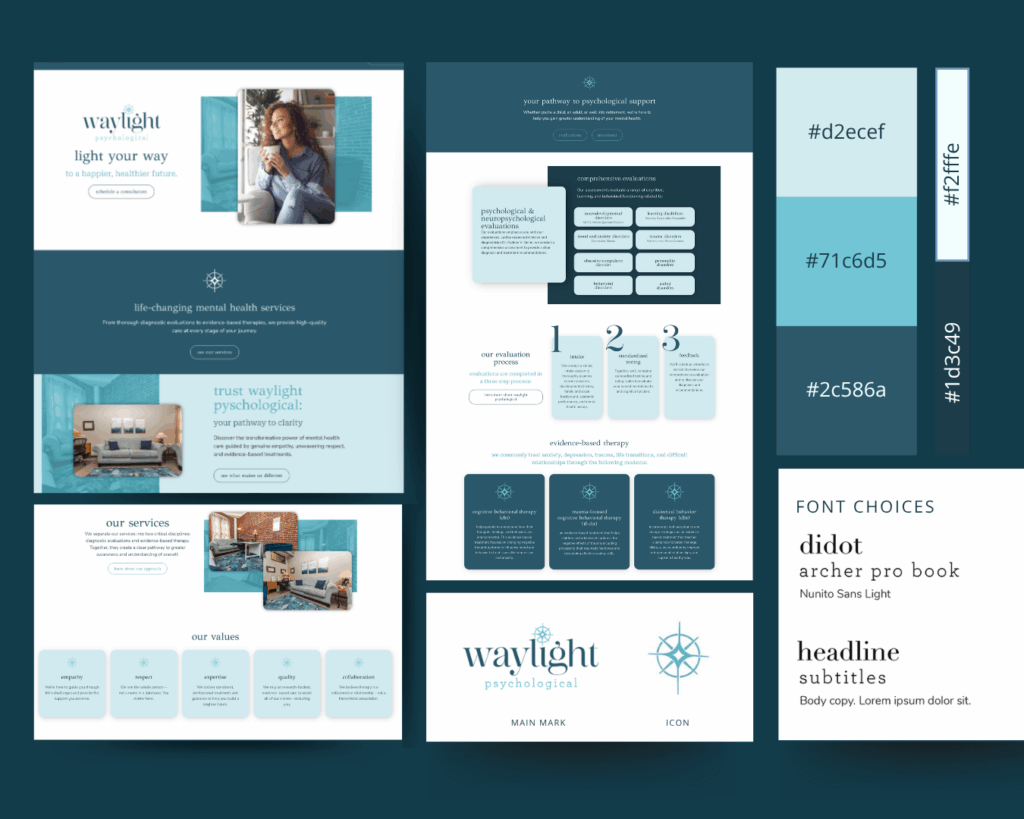
Branding Case Study: Waylight Psychological
The Problem
Dr. Chelsea Grefe McCann was running her business under its legal name—which was just her name.
She wanted to come up with a name—and a brand—that was much more approachable.
The Solution
We worked with Chelsea to understand her, her business, and her audience.
Then we developed a list of potential original names.
The winner: Waylight Psychological.
With the new company name, we got to work developing a logo.
Once that was approved, we then wrote and designed a website that aligned with the new brand.
The Testimonial
Here’s what Chelsea, the owner of Waylight Psychological, said about her experience:
Poetica takes a personalized approach in getting to know their clients to create and deliver a product that best represents their client and meet their professional needs. In working with Pat and his team, communication was effective and timely, and I appreciated being an active collaborator in the process. I would highly recommend Poetica to any professional with marketing needs.
2. Create Content
I know, I know, I’ve heard it before: Why does being a business owner mean I need to be a content creator?
Here’s why, in a nutshell: Today’s clients have an overwhelming number of options, and they want to know that they’ve picked the right therapist before they jump into a session.
The two easiest ways to vet a therapist?
- Look at their content to gauge their personality and expertise.
- Look at their reviews to see how their past clients talk about them.
That’s why it’s so important to create content on a regular basis. Some of the most powerful pathways you can take:
1. Social Media
Here’s great news about social media—especially if you hate feeling like you’re selling: Some of the biggest therapists online don’t focus on selling.
They focus on providing value.
That’s it. The sales come as a natural extension of that.
Social Media Example 1: Dr. Nicole LePera
Psychologist Dr. Nicole LePera has amassed 9 million Instagram followers (@the.holistic.psychologist).
Many of her posts are simple text graphics paired with a relatable short story, like this one:
Of course, once people start to follow her and check out her profile, then they realize her services and books that are available for purchase.
Occasionally, though, she’ll show herself on camera, as she does here:
Social Media Example 2: Nedra Glover Tawwab
Therapist Nedra Tawwab has earned nearly 2 million Instagram followers (@nedratawwab), and, interestingly, her approach is similar to Dr. LePera’s.
She also posts many text-based images…
…But she also creates her own reels:
Despite that, though, what I love most about her approach is the first line of her bio (in August of 2026, anyway):
“I help people set boundaries to have better relationships.”
Consider how simple and effective that is.
If you have trouble with boundaries and relationships, you’re in the right place.
If you don’t have trouble with boundaries and relationships, that’s OK! This account probably isn’t for you.
Remember: Marketing isn’t about reaching everyone. It’s about reaching the right people.
2. SEO / GEO
Here’s the nice thing about SEO (search engine optimization) and GEO (generative engine optimization) in the therapy space:
There’s not a ton of real competition.
Yes, this is a crowded space, but remember: Most therapists don’t like marketing.
And that means most of them aren’t making a serious attempt at SEO.
Which means more opportunities for you!
SEO Primer
Here’s everything you need to know about SEO in 111 words:
SEO is a business. Google is worth $1+ trillion in part because of the ads on the search engine results page.
The only way it gets to show these ads is by acquiring and retaining users.
Google acquires users by being synonymous with search, but it retains them by being the best search engine in the world.
Being the best search engine requires finding the best results for each query, and finding the best result requires ranking pages based on their content and user experience (UX).
When in doubt, always compete to deliver the best content and UX possible.
That helps your readers. And it helps Google retain users—and make money.
How to Create Great SEO Content
While there are numerous layers to SEO, here are some of the basics to keep in mind.
- Write for what your audience is searching for. This is the heart of SEO; you’ll never get found if you don’t write to answer your audience’s most burning questions. So, how do you figure out what people are searching for? Well, Google Keyword Planner is one starting point, but it (quite frankly) stinks. Choose something a bit more powerful, like Mangools, or get super serious with Semrush or Moz (expensive options). Tip: Write for keywords with high search volume and low difficulty rating—it’s easier to show up in search results!
- Offer a unique perspective. You’re an expert in your craft, and that matters. Google wants to show content that offers a new, first-hand perspective—instead of the same, generic slop everyone else writes (or generates with AI). So, consider this: What unique perspective can you offer that no one else can?
- Get high-value backlinks. One of the best things you can do for SEO actually takes place off of your website: Build a robust backlink portfolio. In simple terms, a backlink is when another website links to yours, making your website appear more authoritative. A few backlink strategies worth exploring: swap blogs with your partners, appear in podcast interviews, and guest post in industry publications.
I should note: The purpose of the above list is to give you a high-level overview of accessible SEO knowledge. Contact us if you have additional questions or would like to book a consultation!
Related Reading: SEO In 2026: What You Need to Know
How to Create A Great User Experience
Here are some of the easier things to check to make sure you offer a great user experience:
- Have a fast website. Google’s PageSpeed Insights is a free, quick tool for getting a technical score for your webpage—and recommendations on next steps.
- Add alt text to your images. A lot of small businesses (and therapists) forget to do this! Alt text is descriptive text that describes what’s in a picture to support search engines and people with screen readers.
- Make sure your links work. Everything on your website should work properly, especially your links and buttons to other pages and resources. If something’s broken, it creates bad UX.
SEO / GEO In 2026 & Beyond
We’ve seen major shifts in SEO and GEO in recent years, and here are some of the most important notes as succinct as we can make them:
- Reddit is now a major player in the SEO space because readers want to find insights, ideas, and opinions from other humans. This is frustrating for therapists and other business owners because Reddit has strict rules about self-promotion. Bottom line: Using Reddit as a marketing avenue is as big of a decision as starting a Facebook or Instagram account—and you won’t see success with any of them if you don’t really work at it.
- GEO likes content to be super organized. That means following proper protocols for headers, using tables of contents, slipping in a FAQ—and more.
- Unique content matters. We already mentioned this earlier, but it’s worth repeating: Offer a unique perspective. Instead of trying to provide the same, tired content as everyone else, deliver something different from the competition. Tip: Lean on your own experience and insights as a starting point.
SEO Case Study
The Problem
A therapy practice in Pittsburgh’s North Hills came to us when they were a small team with a modest website that generated about 30–60 site visits per month.
Obviously, they wanted to increase their site traffic—and their bookings.
The Solution
Through a steady stream of high-quality blogs (about two per month), we increased their site traffic to about 3,000 organic site visitors per month—and they were able to double their team size in the process.
Even better: They were able to spin their success into a sister business, which has become a new, exciting source of revenue for the organization.
3. Ads
Should paid advertising tactics really be in the “create content” section?
Yes and no.
Ads don’t work “organically” like the other strategies we’ve discussed, but they do require a bit of creative elbow grease.
Plus, they can be a powerful tool for reaching a wider audience—and generating new consultations.
4. Email Newsletters
Email marketing might not be as flashy as social media or as exciting as watching your website climb the search rankings.
But it's one of the highest-return marketing channels available.
Why?
Because unlike social media, where algorithms decide who sees your content, your email list belongs to you. If someone has trusted you enough to hand over their email address, they've already taken the first step toward building a relationship.
That's incredibly valuable.
The key, though, is understanding what people actually want in their inbox.
Spoiler alert: It's probably not another sales pitch.
Instead, think about how you can continue helping people between sessions—or before they ever become clients.
Ideas include:
- Practical coping strategies for anxiety, stress, or burnout
- Book recommendations that have influenced your work
- Short mindfulness or grounding exercises
- Commentary on common mental health misconceptions
- Updates about workshops, support groups, or community events
- New blog posts or podcast episodes
- Personal reflections or stories that reinforce your expertise and approach
Notice a pattern?
Almost all of these provide value first.
That's important because trust is the foundation of every successful therapy practice, and trust is built long before someone schedules their first appointment.
If someone spends six months reading your newsletters before finally reaching out, your marketing has already done its job. They already know your voice. They understand your philosophy. They feel like they know you.
That makes taking the next step much less intimidating.
One more tip: Consistency matters far more than frequency.
You don't need to send an email every week if you can't sustain it. A thoughtful monthly newsletter is far more effective than sending three emails in one month and then disappearing for the next six.
Partner With Potential Referral Sources
One of the quickest strategies to building a steady stream of referrals is to build relationships with referral partners—non-competing professionals who share your target audience and can refer business back and forth with you.
We’re talking professionals like:
- Chiropractors (who often work with individuals who’ve been in an accident or experienced trauma)
- Yogis (who often work with individuals who desire physical, spiritual, and mental health)
- Acupuncturists (who often work with individuals who are open to non-traditional treatment strategies for complex issues)
- Doctors (who often engage with people in need, but are only able to support the physical issues—not the mental or emotional wounds)
There’s an art to building referral relationships. While you can build relationships by joining networking opportunities like BNI or Chamber of Commerce, you can also use these strategies:
1. Grab Coffee to Discuss Potential Referrals
Talk through your last ten clients or appointments. What did they need support with? How can you potentially support each other?
2. Collaborate On Live Events
We’re obviously biased when it comes to live events, but there’s a reason: They’re one of the quickest, most effective strategies for reaching your target audience and turning them into paying clients.
Opportunities to consider:
- Wellness Workshop - Host a lunch or evening workshop open to the public, and work together to promote it. Once there, you’ll have a chance to discuss the transformative power of therapy (while establishing yourself as an obvious, trustworthy resource).
- Paint Night - Paint nights are fun, relaxed, and popular—and they can give you a captive audience to talk about the therapeutic benefits of art (and your own therapy services).
- Fun Run - A casual fun run will attract individuals who are already interested in good health, and these individuals could be in need of mental health support.
- Fundraiser - Pick a nonprofit you both believe in, then actively promote your fundraiser together. This will help your brand get in front of your partner’s audience (and they’ll get in front of yours).
Note: These collaborations work best when both parties are fully invested in their success. For best results, work with someone who already has a robust email list, an engaged social media following, and strong connections with the community.
3. Foster the Relationship Long-Term
A referral relationship is like any other relationship: the more you nurture it, the better it grows.
But the more you ignore it, the faster it dies off.
Make time to consistently communicate and collaborate with your referral partners, and you build powerful (and meaningful) long-term relationships.
4 of our Favorite Therapy Marketing Ideas
So, we've already explored some of our best advice for marketing your therapy practice, but we also realize we got quite technical in there.
So, here are four of our favorite therapy marketing ideas—without as much technical jargon:
1. Build a powerful "lead magnet," and follow it up with an email "nurture" campaign. I know, I know. I just said I wouldn't use as much jargon.
A "lead magnet" is any sort of downloadable eBook or PDF you make available only if someone offers you their email in exchange.
(Example: You could write a brief eBook on how to handle high-stress situations, but people can only access it when they fill out a sign-up form.)
You then use a tool like Mailchimp or Flodesk to send pre-scheduled emails that gradually warm them to you and your brand—eventually resulting in a new client.
2. Start a podcast. Look, I'll be honest: Starting a podcast is more work than you think.
But it can create some wonderful opportunities to connect with people.
And it makes your sales easier.
And it'll generate more leads for your business.
So, while a podcast is certainly plenty of work, it also provides some really cool benefits.
3. Find two or three really good referral partners. Years ago, I watched a nutritionist and a chiropractor help each other grow their businesses by sending a steady stream of referrals back and forth.
And it makes sense. A nutritionist often works with individuals who are looking to lose weight because of chronic back issues—which is often a great connection for a chiropractor. And chiropractors often work with individuals who would benefit from shedding a few pounds and following a healthier diet.
As a therapist, you also have a similar opportunity to connect with professionals who have no overlap with your business.
Consider the following:
- A chiropractor who often deals with car accident victims—victims who are now dealing with the trauma of such a life-changing event.
- A yogi who helps women find peace after escaping abusive relationships.
- A family attorney who often helps families struggling through the turmoil of their lives falling apart.
The opportunities are out there!
4. Create beautiful branding assets. Keep a stockpile of business cards, brochures, and flyers on hand to distribute at community events and networking events.
As we mentioned earlier, a well-developed brand is priceless, and high-quality assets immediately boost trust and credibility.
Find Marketing Support
If you’re ready for third-party marketing support, contact us. We’d love to share our first-hand experiences from the therapy world—including all of our therapy marketing ideas.
Contact us to get started.