
Editor’s Note: This article is Part 1 in a three-part series on Attracting, Capturing, and Converting eager leads into brand loyalists. We’re also linking to Part 2 and Part 3 here.
2026 had a rough start. Everywhere you looked, it was bad news:
- The job market was terrible.
- The stock market was in decline.
- AI was destroying jobs.
- We were on the brink of World War 3.
You get the idea.
With so much chaos, consumers and businesses alike reevaluated their spending habits, and the shockwaves ripped through companies across the United States.
That impact is ongoing.
Now is the time to revisit your marketing strategy.
Now is the time to get serious.
Now is the time to compete.
With that in mind, we’ve launched a three-part series that dissects how to Attract, Capture, and Convert high-quality leads into enthusiastic customers.
Welcome to Part 1.
Questions to Get Started
Building any sort of branding or marketing strategy starts with a complex series of interrelated questions. Skip any one of them, and you risk blowing up your entire campaign.
But if you sit with these questions and really think about the answer, you’ll grow faster than ever.
Here’s what you should consider:
1. What’s your target audience’s biggest pain point?
No matter what industry you’re in, you’re a problem-solver first and foremost. And the bigger the problems you solve, the more invaluable you become to your customers.
But it’s up to you to really understand what customers are really after.
If you’ve ever seen The Wolf of Wall Street, you’ve probably seen the “Sell me this pen” scene, when a character is handed a simple pen and asked to sell it.
This classic sales test works because it checks whether the salesperson really understands a fundamental truth:
It’s not about the pen.
It’s about the customer.
If you’re trying to sell the pen, you don’t hype up how much ink it holds, how affordable it is, or which surfaces it writes on.
Instead, you dig into the pain points:
- Why are you in the market for a pen?
- What types of pens have you used in the past?
- What do you plan to use a pen for?
All of this is critical for understanding the target audience.
It’s also critical for formulating your messaging—but we’ll talk about that more in a moment.
2. What makes your company valuable?
While we’re thinking about the customer’s problems, let’s also think about the solutions you provide.
Remember: Your value isn’t in the service or product. It’s in the emotional impact and tangible outcomes.
In literally everything, your value either stems from emotion, outcomes, or a blend of both.
Take Fogo de Chão, for example. The popular Brazilian steakhouse isn’t successful because people say, “I’m hungry—let’s go to Fogo so I feel full again.” Instead, they head to Fogo for the experience—the emotional impact it has (and certainly not for the financial outcomes).
For another example, think about your preferred automechanic. There’s a good chance you stick with them because:
- You trust them with your vehicle (emotion)
- They price their services reasonably based on the value provided (outcome)
- They’re conveniently located near your home (emotion and outcome)
Understanding your value helps you refine your messaging and branding—which we’ll discuss momentarily.
3. What makes your company unique?
OK, now it’s time for the hardest question of all.
If you can’t answer this one right away, that’s OK. It’s a question most business owners wrestle with—and it’s one many fail to ever answer.
But having a firm response makes all of your marketing significantly easier.
Seriously.
Knowing what makes you unique:
- Simplifies your messaging.
- Streamlines your branding efforts.
- Streamlines your marketing efforts.
- Gives your salespeople more firepower.
- Makes your messaging more memorable.
So, how do you start?
Some people like to start by thinking about the Hedgehog Concept developed by Jim Collins.
Others suggest starting with the Japanese concept of Ikigai.
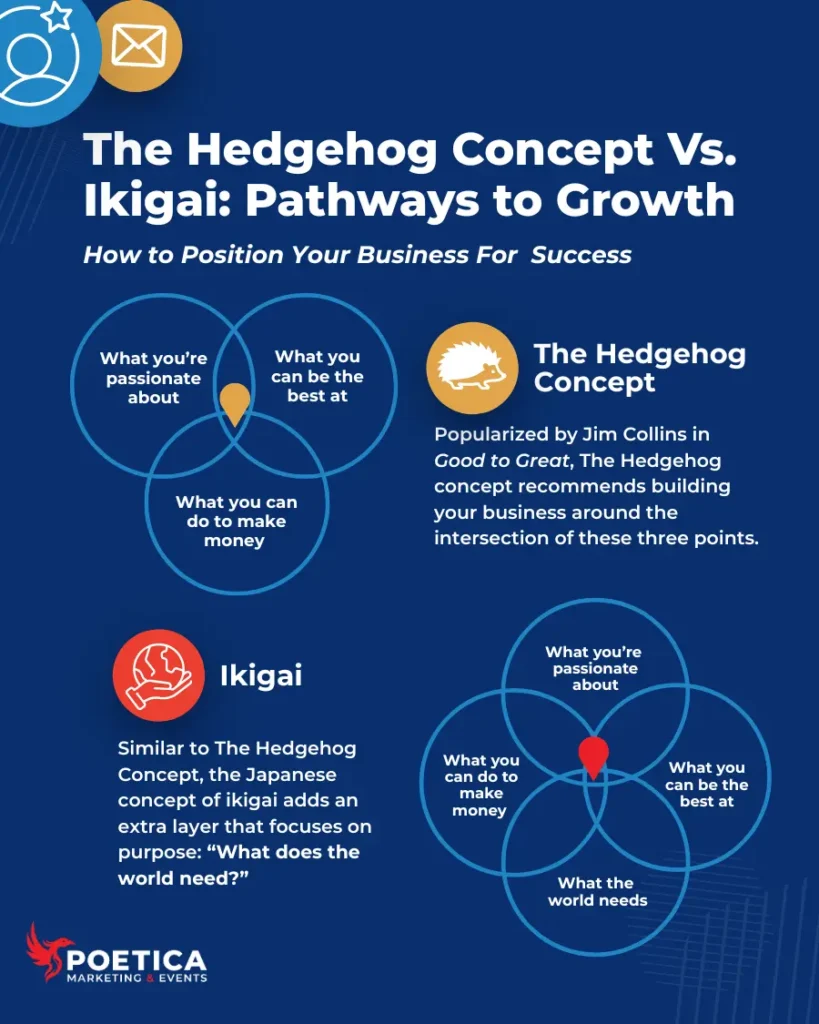
The trick to using these concepts is to dig as deep as possible into each question.
(Let’s get back to our roofing example. Maybe you can’t automatically be the best roofer in your region, but maybe you can become the best roofer with a specific type of roof or on a certain angle. Remember: Nuance is everything.)
Another angle: Sit down and think about all of your competitors.
What’s something you have that no one else can claim?
Maybe it’s a process. Maybe it’s a certification. Maybe it’s experience. Whatever it is, find it.
Nail the Messaging
The next step in attracting your audience? Perfecting your messaging.
And it’s easier said than done.
In a perfect world, your message should:
- Fit into a single sentence.
- Solve a pain point.
- Differentiate your brand.
As an example, take a look at this post about Brex, the corporate card:
The message on the billboard is simple:
Don’t charge it, Brex it.
The first corporate card for startups, not the political disaster.
It’s simple. Funny. Memorable.
And, as RJ points out in his post, it was the cornerstone to a larger campaign (more on campaigns in a minute).
Now, it is worth mentioning, quite quickly, that there are ways this could have been improved further. A few subtle (but meaningful) changes:
Don’t charge it. Brex it.*
*The first corporate card for startups. Not the UK political disaster.
My first rule of writing has always been, Seek to be understood on the first read. These changes to punctuation and formatting:
- Draw greater attention to the Brex name.
- Signal that the second line is an annotation—not a complete sentence.
- Hit the humor harder.
Now, to be fair, condensing your message down like this is hard. I’ve been writing professionally for more than a decade now, and even I’ll admit that writing shorter messages is often harder than long posts.
(Actually, this reminds me of that witty email joke: I didn’t have time to write you a short email, so I wrote you a long one).
Great messaging is efficient. And that’s why it works.
Your audience is busy.
And they don’t want to be marketed to.
So, write something that cuts through the noise.
Develop Your Content Strategy
I’ll do my best to curtail my content strategist excitement so we can keep this post to a reasonable length.
Here’s what you need to know:
Whether you realize it or not, your audience is in the middle of a funnel.
In The New SMB Owner’s 101 Guide to Marketing, I pulled in a couple of helpful visuals:

To be fair, there has been frequent debate recently in the marketing world about whether or not the traditional funnel truly exists anymore, given how much consumer behavior has evolved. Regardless, it’s a helpful tool for understanding the buying process.
At any point, your audience is working their way through the funnel to take some sort of action—either working with you or working with a competitor.
Control the funnel, and you control the sale.
Fortunately, you can create content for every stage of the funnel. A few examples:
- Organic Social Media - Your social efforts are excellent for Awareness- and Consideration- level content.
- Digital Ads - These are excellent for Awareness, Consideration, and Decision, but they’re especially impactful for pushing through the Decision stage.
- SEO/GEO - Optimizing for search engines (both traditional and AI) helps you dominate during Consideration and Decision (though you can also use it for Awareness-level campaigns).
- Email - Email is excellent during Consideration and Decision.
Your content can be used, recycled, and optimized across all channels, helping you achieve high “mileage per content”—a term I use to refer to squeezing as much value as possible from every asset you create.
Here’s the most important part: The best messaging cultivates community.
Don’t focus on blasting your message out and beating people over the head with offers. Instead, make them feel like you understand them personally, and foster meaningful connections (like exclusive subscriber benefits, for example) that deepen their emotional ties to your brand.
If you haven’t seen it yet, it’s worth diving into our webinar on Brand Strategy. In it, Lead Designer Nicole Suchin touches on the research behind emotions, community, and brand connections.
If you don’t feel like watching, here’s the short version. Research shows:
- People can form relational attachments to brands.
- Your brand chemistry is altered by positive, emotive brand experiences.
- Humans prefer human-centric branding.
We like to think we’re sophisticated creatures. We’re not. Create direct, compelling, emotive messaging and branding, and you’ll stand out.
Adding Brand & Design
Note: This section was written in collaboration with Poetica Marketing Lead Designer Nicole Suchin.
Of course, your messaging is only as valuable as your ability to grab attention. And that’s where your visual branding, graphic design, landing pages, and videography come into play.
Your branding—your company’s visual identity—is a critical part of your overall first impression.
The question is: How can you manage to resonate with your audience while standing out from the competition and stating your own identity?
Another way to approach it:
How can you stand out on a shelf?
As a starting point, take a look at this post we saved from Katerina Kotrupas:
Here’s Katerina’s point:
Not only do these products fail to stand out against each other—they fail to stand out against different products.
This is the fatal flaw we see over and over and over again.
Roofing companies use the classic A-frame roof as their logo.
Car detailing shops use the shape of a sleek European sports car as their logo.
Accounting companies use the up-and-to-the-right bar charts as their logo.
When everyone looks the same, consumers struggle. Inevitably, they resort back to emotions and outcomes—with a heavy preference on price.
And we all know: You don’t want to compete on price. That’s a recipe for a difficult business.
So, ask this question:
How do I create content that stands out everywhere?
How do you create a campaign that stands out on:
- Billboards
- Digital Ads
- Social Media Posts
- Websites
The ultimate goal is to create something so undeniably you that you can take your logo off and it still looks like it came from your brand.
Take, for example, this latest project with ZenShield. The founder, Joy, came to us with a unique product that she wanted to launch into one of the most competitive and actively growing markets – the retail industry for women’s fitness apparel.
I worked in design for retail before joining Poetica, and so there were a few thoughts I had right off the bat about what the logo should look like and its functionality. One of the most important being that it had to be clean and adaptable to multiple uses. Joy mentioned wanting it to be dynamic, not overly feminine, made for the post-partum woman, and not just look like another Lululemon knock-off, so we kept these in mind during our concepting phase.
In the end, we went with a customized wordmark that allows for the first letter to stand out as its own independent lettermark. This allows the lettermark to be used alone on the product and labels, while the full wordmark can be used across other major marketing pieces, giving us a strong foundational piece for the overall brand. We also shifted the color palette from a dark purple, a color that’s overused in the women’s fitness apparel space, to an electric green, as this felt much more refreshing and vibrant.
Events For Attraction
Note: This section was written in collaboration with Poetica Marketing Event Specialist Regina Schober.
Live events are powerful. Sure, events are immersive, memorable experiences, but they’re also huge marketing beats—perfect for boosting visibility and attraction.
That’s because events are…
- Visible - When Mt. Washington puts a Ferris wheel on Grandview Avenue for Party on the Mount so the entire city can see—that’s a big deal.
- Fun - We talked about emotional impact early on in this article. Fun is emotion—and it has staying power in the mind.
- Community - Events bring people together. Those connections feel into emotions, but they’re also just good for business.
- Marketing - Successful events require marketing, and marketing creates momentum. Even better: An event creates opportunities for future marketing, through photos, video, testimonial, and messaging.
As a quick case study: We helped the Seton Center through a massive 40th anniversary party in Brookline last summer. The event attracted hundreds of local Brookline residents—some of whom didn’t even know about Seton Center’s day care services for children and adults.
But through the event marketing and the memories formed during the event, you can bet they now know of the closest facility nearest them!
Keep Going
So, where do we go from here?
Well, follow me on LinkedIn if you want to receive a notification about Part 2 and Part 3 (they’ll come out in the next two weeks).
The other option is to get personalized support from the Poetica Marketing team. Message me here or shoot me an email through our contact form.