Editor’s Note: This article is Part 2 in a three-part series on Attracting, Capturing, and Converting eager leads into brand loyalists. Read Part 1 and Part 3.
Years ago, when I was writing The Strategic Marketer, I asked a fellow writer to proofread the third draft.
In one section, I reminded the reader that the majority of their social media followers don’t want to do business with them.
My proofreader left a note in the margin: Wait, what? Then what’s the point?
The biggest disappointment in business is that most people have no interest in doing business with you. That’s true even for your social media followers. Everyone has a certain reason for following you—and the majority of them aren’t because they love your products or services.
It’s simple math, really.
Recently, I was chatting with someone about a new AI-based design tool for WordPress. On the surface, this tool is for any business owner in WordPress (which is a huge portion of the internet).
But that’s not the case. It’s really for:
- Business owners who are in WordPress…
- …who also actively take care of their website…
- …and who have a specific design need that this tool solves…
- …and who are willing to trust AI for design support.
Suddenly, we’ve gone from “huge portion of the internet” to a small slice of overall WordPress users.
Here’s the point: Marketing is hard; you can’t half-ass it and hope for the best.
Real results come from strategy—and gradually turning casual interest and awareness into action.
Today, we’re talking about how to pull your target audience into your lead pipeline.
You Might Be Shooting Yourself In the Foot (The Hidden Lead Gen Problem)
I hate to point fingers, but there’s a good chance you’re self-sabotaging your marketing somewhere. And it’s not necessarily your fault.
Like I said, marketing is hard. And you have to scrutinize everything.
Some of the most common problems we see over and over again:
- Company websites with hard-to-find contact information.
- Nonprofit sites with hard-to-find donate options.
- Hero sections of websites without compelling text (see Part 1 of this series for a brief primer, or read my Copywriting Mastermind)
- About pages that don’t discuss the accomplishments of team members (especially client-facing team members)
Before you read any further, pause for some self-reflection.
Where are you coming up short?
Once you’ve identified your weaknesses, move on to the next section.
Turning Your Digital Footprint Into Leads
Some of the best ways to generate organic online leads include:
Build Lead Magnets
Gated content was supposed to die out 5–10 years ago, but it still generates leads.
The hack in 2026 and beyond? Create hyper-specific, high-quality content (that can’t quickly be found through a Google search) for a niche audience.
Your gated content needs to feel like it was made especially for the reader.
Here’s a quick example: Those who have followed me online for some time now probably remember Monster Riff, the online metal blog I used to run.
On Monster Riff, I promoted a 16-page eBook about how to market your metal band. And musicians loved it. Every time I posted about it on Instagram, I’d see 20–40 leads within 24 hours of posting.
A couple of important notes:
- It was a valuable resource. Monster Riff served and underserved community (the stoner rock and doom metal scene). By creating something specifically for those bands, I built a product that stood out to my niche.
- I’d already built trust in the community. Through Monster Riff, I was an emerging voice in the underground metal scene. I ran a podcast, interviewed bands, and regularly published album reviews. Many in the community already knew, liked, and trusted me—and that made generating eBook downloads even easier.
Build Strategic Landing Pages
I recently wrote extensively about how to build effective lead generation landing pages. While you can get a full rundown of tips in that article, here are some of my favorite recommendations:
1. Use Attention-Grabbing Headlines - Your headline should be quick and snappy, and it should root the reader in place.
To quote one of my editors from the beginning of my career: The purpose of your headline is to get the reader to read your first sentence.
(While the focus of this section is writing attention-grabbing headlines, it’s worth writing his entire tip out: The purpose of your headline is to get the reader to read your first sentence. The purpose of the first sentence is to get the reader to read your entire article.)
2. Use Bullets And Numbered Lists - Bulleted and numbered lists are effective because:
- They’re easy to read.
- They simplify “scanning” (Remember: People don’t read online from top to bottom. They scan your text first.)
- They’re an efficient writing hack for you.
See what I did there? 😂
But in all seriousness, these lists are reader-friendly tools that simplify the buyer’s journey. And everything you can do to simplify that journey is valuable to both your target audience and your business.
3. Use Trust Signals/Social Proof - One of the best landing pages I’ve come across recently is Kit’s Features page. I wrote about it in the article I linked above, but its stroke of genius is seamlessly weaving customer testimonial quotes and videos into the landing page copy.
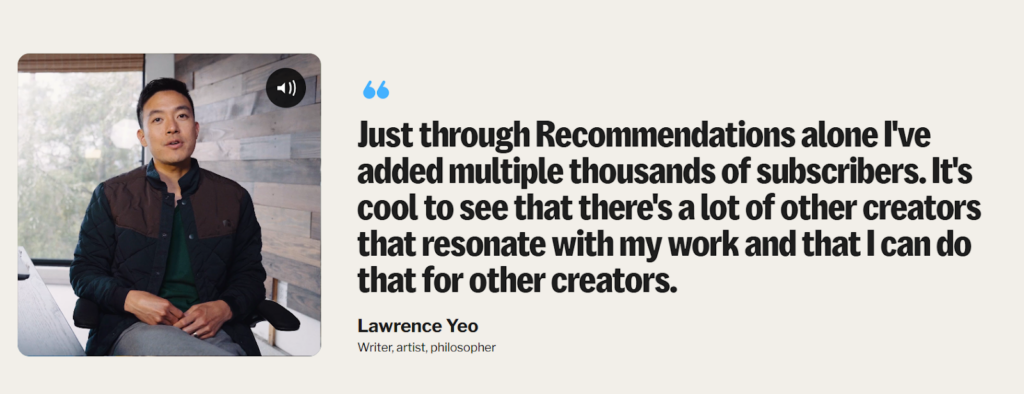
By the time you get to the bottom of the page, you’re already sold and ready to convert.
4. Use High-Value Calls to Action - Your calls to action (the language you use to push someone to take the next step—like in your button text) can have an enormous impact on conversions. For example, imagine two buttons side by side. One says, “Submit” and the other says, “Start Your Journey to Better Leads.” The second one is more compelling because it focuses on the value of taking action. Follow that tactic for your own website and other marketing efforts.
5. Build Custom Landing Pages For Each Campaign. This is the most valuable tip in this entire list: Don’t reuse old landing pages from previous campaigns or purposes and expect them to achieve great results. Map the user journey for each specific campaign, and ensure the messaging and experience are consistent from beginning to end.
Maximizing Design For Lead Generation
Note: This section was written in collaboration with Poetica Marketing Lead Designer Nicole Suchin.
Of course, your copy and overall content strategy is only one portion of your lead generation opportunities.
You can’t afford to neglect your design strategy.
And there’s a ton to think about. In fact, even small changes can have major impacts. For example:
- Button Design - Believe it or not, the design of your buttons can impact conversions. Best practices include: using high-contrast colors to grab attention, including interactive elements (like changing color during a hover), and opting for rounded rectangles instead of shapes with sharp right angles. It’s also important to note that anything that looks like a button could quickly confuse visitors. Try to avoid containing information in small boxes, underlining text, and adding arrows near text, as these are symbols we’ve come to associate with buttons.
- Leverage Strong Imagery – Strong imagery is your #1 tool in capturing attention, and conveying the message of your campaign. Utilizing imagery with people in it is especially powerful as it gives you the ability to convey the emotional payoff of what you’re selling. A happy, excited, or even peaceful expression shows what your product can do for others in a way words can’t. Custom photography is always ideal, but if you’re working with stock consider combining your imagery with texture, illustration, type, or unique colors to stand out visually.
- Match Copy To Design Choices – Copy and design require close partnership when building out your campaign. A headline is only as captivating as you make it look, and a call to action can only entice people who stop to notice it. When it comes to your design choices with type, consider the context of the copy you’re using. If it’s an attention-grabbing headline, use bold, impactful type. If it’s a call to action, use a different color background or image to stop the scroll.
- Visually Separate Pricing Tiers & Discounts – This coincides partly with the above, but it’s something I often see quickly thrown together. Your pricing tiers are the most critical part that visitors will be reviewing with intense scrutiny. There are a few visual cues that site visitors are used to as well to keep in mind. For example, pricing tiers are usually contained in a 3-5 column grid and some form of containment shape. Also, there is usually a ‘Recommended’ option that gives the best value. Separating out the ‘Recommended’ option with a pop color, unique icon, larger text, or other visual effect can make it stand out. If you don’t offer tiers, but instead are running a special discount, the same rules can apply to emphasize the discount’s value.
- Organize Your Landing Page Efficiently – The order in which you organize your page has an impact on how long you’ll hold someone’s attention. Scroll maps continually show that users become less engaged the more they have to scroll, so put all the most important information right at the top. What you’re selling, what the payoff is, and the ability to quickly take action are examples of top-level pieces of your page.
- Keep it Short – To coincide with the previous mention of “the more you scroll the more you lose someone,” it’s important not to fall into the trap of putting everything and anything onto your page. Keep it short, simple, and direct, just like you would any other pitch.
- Continue to Test & Refine – Design is often misunderstood to be just about aesthetics, when really it’s a science. While we can have some basic understanding of how a person might interact with a page, and build a design to fit that, we cannot know the exact formula unless we continually test it and refine accordingly. I’m not saying to change your page every day. Rather, after gathering enough user data – such as observing click and scroll behavior – adjust any spots where you’re seeing a lack of interaction. For example, if you notice people aren’t clicking your CTA, try making the type bigger, or switch out the image to something more captivating.
Tracking Behavior For Better Results
Remember: You can track everything.
One of the biggest mistakes we see over and over again is SMBs taking risky chances without ever stopping to evaluate their decisions.
And tracking doesn’t have to be difficult. Yes, you can set up tools like HotJar to dig deep into user behavior (and it’s certainly not a bad idea to use something like this), but you can still get plenty of value out of the free metrics available in GA4 (Google Analytics 4).
Yes, there’s a learning curve involved—but GA4 has the potential to become one of your most powerful resources once you understand what you’re looking for (and you can also use Google’s Looker Studio to build out convenient dashboards that highlight and update your most mission-critical data points).
If you need a hand with GA4, just shoot me a message here. I’m always happy to talk shop!
Bottom Line: If you’re going to make substantial design changes, track your performance before and after to truly understand the impact—and to catch any mistakes you might make in the process.
Turn Live Engagements Into Valuable Leads
Note: This section was written in collaboration with Poetica Marketing Event Specialist Regina Schober.
Look, we’ve written extensively about the community-building and ROI-generating marketing power of live events over on the Poetica Marketing blog.
That’s old news at this point.
Here’s what we want to focus on today: The lead-generating beauty of live events is the multiple opportunities to collect contact information from attendees.
We’re talking:
- Event Registration (which often requires email or a phone number)
- Event Check-In (which often requires email or a phone number)
- Sign-Up Opportunities for Products/Services or Future Campaigns (which usually requires an email)
- Purchase Receipts (which can be sent via email)
Think about it: Your attendees have already signaled they’re interested in (and aware of) your brand. Now you have their contact information. Start working on those sales!
Events also provide another juicy marketing boost:
When your event includes vendors or sponsors, those partners are incentivized to market your event as well—often to their own existing audiences. That means you can reach a wider swath of your ideal population without paying for advertising.
How to Follow-Up After Your Event
Once you’ve collected the contact information, you have to make an important distinction for each sign-up:
Is this individual ready for our sales pipeline, or should we continue to nurture them through our marketing funnels?
To help, create separate processes for each triggering event.
So, if someone purchases a ticket to your event and purchases something at your event, they’re probably ready to talk more about your other offerings.
But if someone purchases a ticket at the door on the day-of, they may need to learn more before dropping into your sales process.
Keep Going
So, where do we go from here?
Well, follow me on LinkedIn if you want to receive a notification about Part 3. I’ll publish it next week.
The other option is to get personalized support from the Poetica Marketing team. Message me here or shoot me an email through our contact form.